

Blog #1 So, what is Peakbalance (and what's in it for me)??
- jeremyfoster1
- Jun 27, 2024
- 3 min read

Updated: Jul 11, 2024
I was first introduced to the idea of the inverted u curve when I read ‘Blink’ by Malcolm Gladwell. Although he named the core idea of that book to be about ‘thin slicing’ I really understood the theme when reading ‘David and Goliath’ by the same author, where the concept was explicitly introduced.
In David and Goliath, Gladwell introduces the model of the inverted U curve which describes the impact of doing anything (Y axis) from zero to infinity (X axis).
In some ways, it's reminiscent of 'diminishing returns' but I think it's more profound than that.

As a practical way to think about this inverted U curve, consider the act of planning.
If we do zero planning, we’re in a state of chaos. No-one knows what the hell is going on.
However if we do an infinite amount of planning, we are inert. We don’t achieve anything.
Of course people operating in a state of chaos don’t say: ‘We’re in chaos and no one knows what’s going on!’.. these people say.. ‘We’re agile!’.
Also, people operating in a state of inertia don’t say ‘We spend all our time planning and never actually do anything!’ these people say ‘We’re thorough!’.
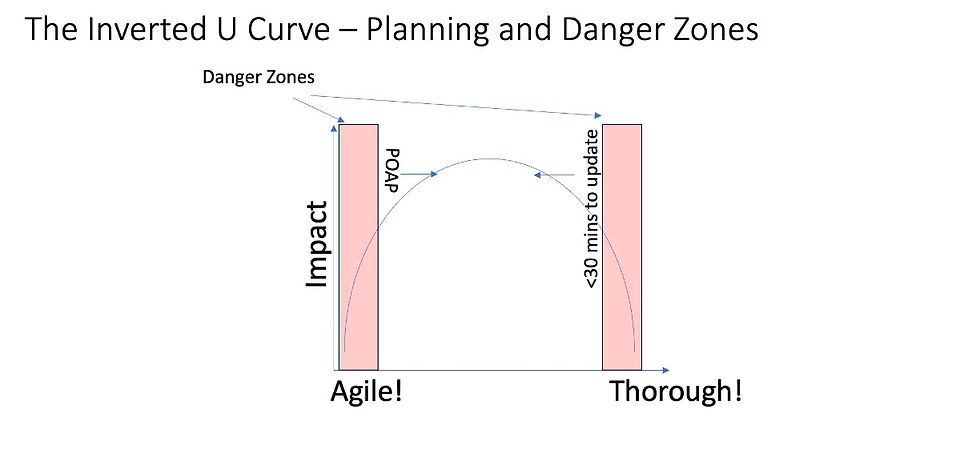
Good ideas (being agile or thorough) can quickly take us to bad places. As per the 'Danger Zones' indicated in the model below.

So a couple of things occurred to me as I was reflecting on the inverted U curve.
Firstly, there are multitude of inverted U curves at play on any given situation.
That depending on the moment, the peak of impact could change. In fact it was continuously changing.
It occurred to me, that if we overlay multiple inverted U curves onto each other and they’re all moving, it looks a lot like a bowl of upside-down jelly.

So what are the forces that impact the jelly? Well pretty much everything:
Our ambitions.
Our actions.
Our competition.
Our suppliers.
Ecosystem changes.
The list goes on.
The forces are continuously changing and there’s nothing we can do about the fact that change is guaranteed. The plate is like a collection of plans and the Jelly is value or impact of those plans.
Which brings me back to Peakbalance and this blog. The first of a weekly effort.
My hypothesis is that to be good, we have to know what 'bad' is and take action to avoid being bad. That if we do that, we'll float around the higher impact / value area and we'll stay away from the poor impact / low value area.
Often 'good ideas' take us to a bad place (think 'just a few more data points!). We need to focus on value and impact.
So how about something practical to consider:
In the model below, you can see that having a Plan On A Page keeps us out of the 'Agile' (code for Chaos!!) part of the curve. Also, ensuring that any plan update takes <30 mins to complete, keeps us out of the 'Thorough!' part of the curve (code for inert and achieving nothing!!)
In a future Blog I'll share my model for a Plan On A Page which captures 5 critical items, enough to champion any effort.
For those of you that know me, I love models. My passion for them comes from a place of trying to explain to myself the logic of why people and organisations act the way they do. Why things go go right and why things can go very wrong.
The 'Peak' in Peakbalance is about maximising value and impact. The 'balance' is recognising tradeoffs and choosing deliberately. Every time I think of Peakbalance, I'm thinking of finding that best outcome, in a dynamic and forever changing world.
Throughout this blog, I'm going to share observations and hopefully you'll notice some truisms in your world. I'd love to see your comments below. Please don't hold back!
The inverted U curve is a common theme, so will pop up here at bit. However, I'll be looking to strike that Peakbalance, so will work hard to not over-do it. Lets see.
Updates will be once a week. Not too few and not to many.


Comments